
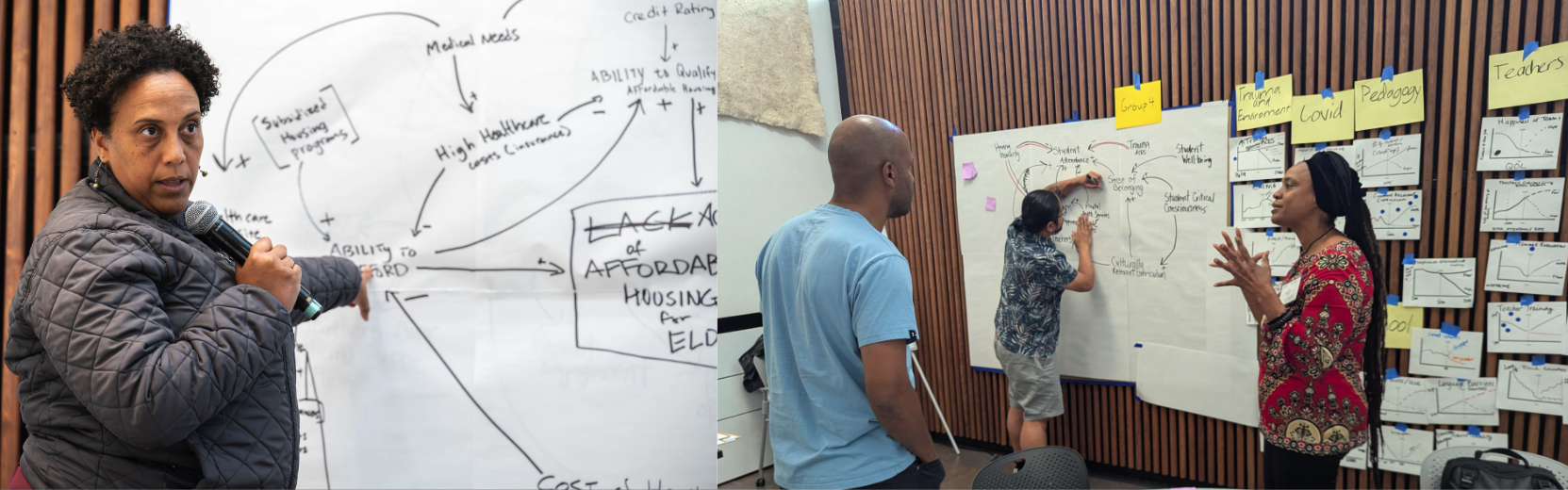
From left to right: Wren Amos, Walter Wallace, Ivan Natividad, and Sherry Wilson.
Community Based System Dynamics
Workshop and Learning Lab
April 16-17, 2026
@the Oakland, CA
About this Report
This report summarizes the process and outcomes of a free 2-day community based system dynamics (CBSD) workshop and learning lab held April -16-17, 2026 at the Kapor Center in Oakland, CA. This work was made possible by generous support from the Kapor Foundation and the Marguerite Casey Foundation.
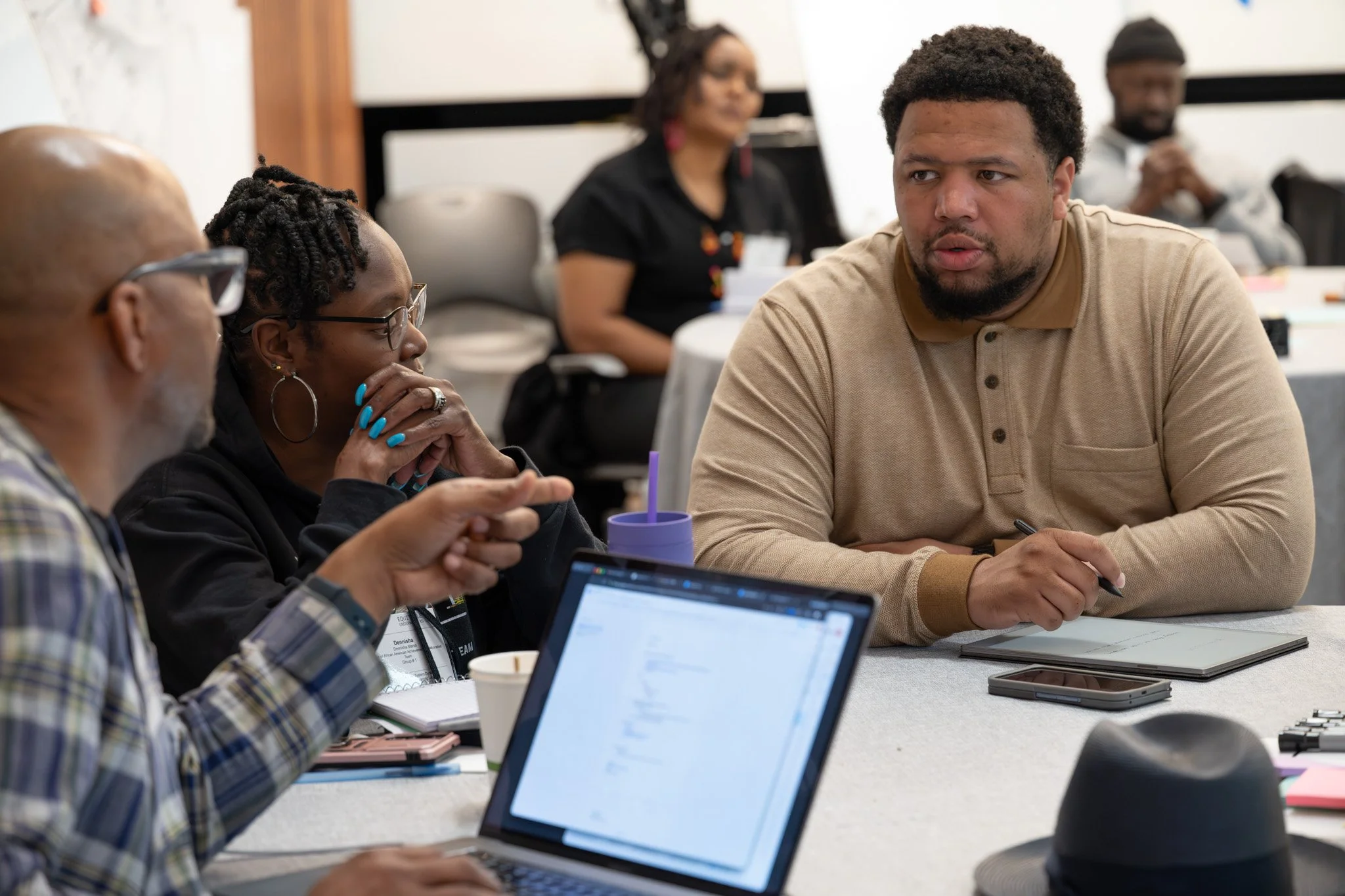
From left to right: Randolph Belle, Dennisha Marsh and Paris Davis.
“It was an amazing experience. I learned a lot and I have made new connections. I learned that we are all AI developers when we use AI and that most systems are not created with our societal environments in mind.”
Workshop Purpose and Goals
In order to apply machine learning and AI technologies in ways that amplify human agency and benefit society, a deep understanding of the societal context that surrounds the problems we intend to solve is a necessity.
Community based system dynamics (CBSD) is a learning method for ‘going below the surface‘ to acquire the deep problem understanding necessary to make societal context knowledge legible and useful for both humans and machines.
In an age where everyone is becoming an ‘AI developer’ it's critical to build the capacity to understand problems as systems and produce societal context knowledge in those who are proximate to and driving towards solving complex societal problems.
This community-based capacity to produce societal context knowledge is foundational to building the participatory infrastructure we need to build socially beneficial AI.
We brought together 15 Bay Area change-makers who serve Oakland to take the first step in creating a local cohort of systems thinkers and societal context knowledge producers.
Our main goals were to:
build beginner-level capability and capacity in the community based system dynamics (CBSD) methodology
produce an initial model that might be useful for building a quantitative model and simulation interface
plant the seeds for a local CBSD community of practice for continuous learning and sustainable impact
The Participants (the community)
The workshop cohort represents a broad spectrum of Bay Area organization and issue areas. We purposely focused on recruiting organizational leaders and decision makers - including social-impact entrepreneurs - who could take what they learned and amplify its impact within their organizations and across their communities and networks. Their collective work spans critical sectors including the arts, health & wellness, community development, nonprofit capacity building, education and youth mentorship, social equity, justice, and food systems.
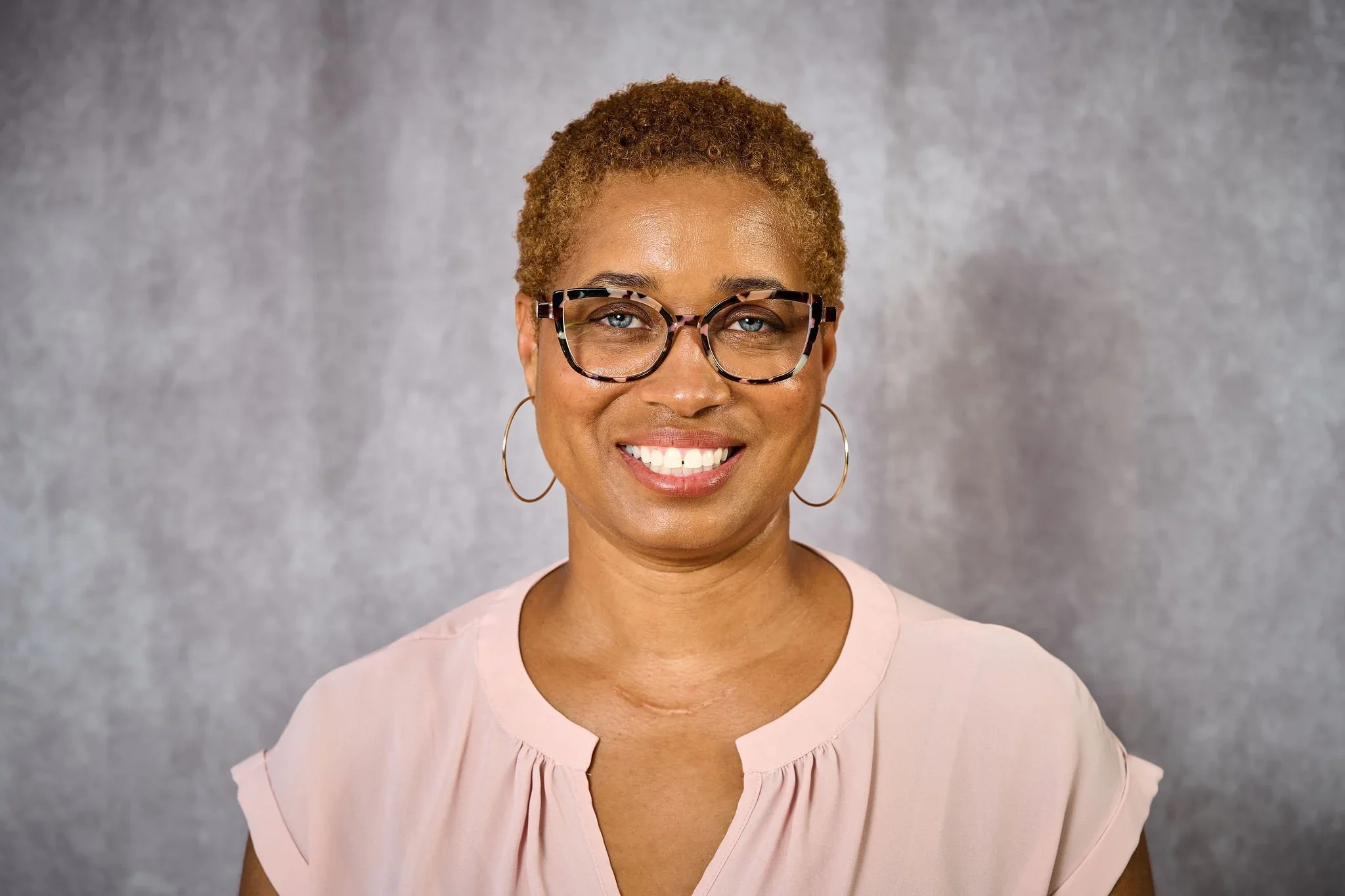
Carli R. Kyles, Ph.D.
Founder + Executive Director
Amplify + Go Girls!
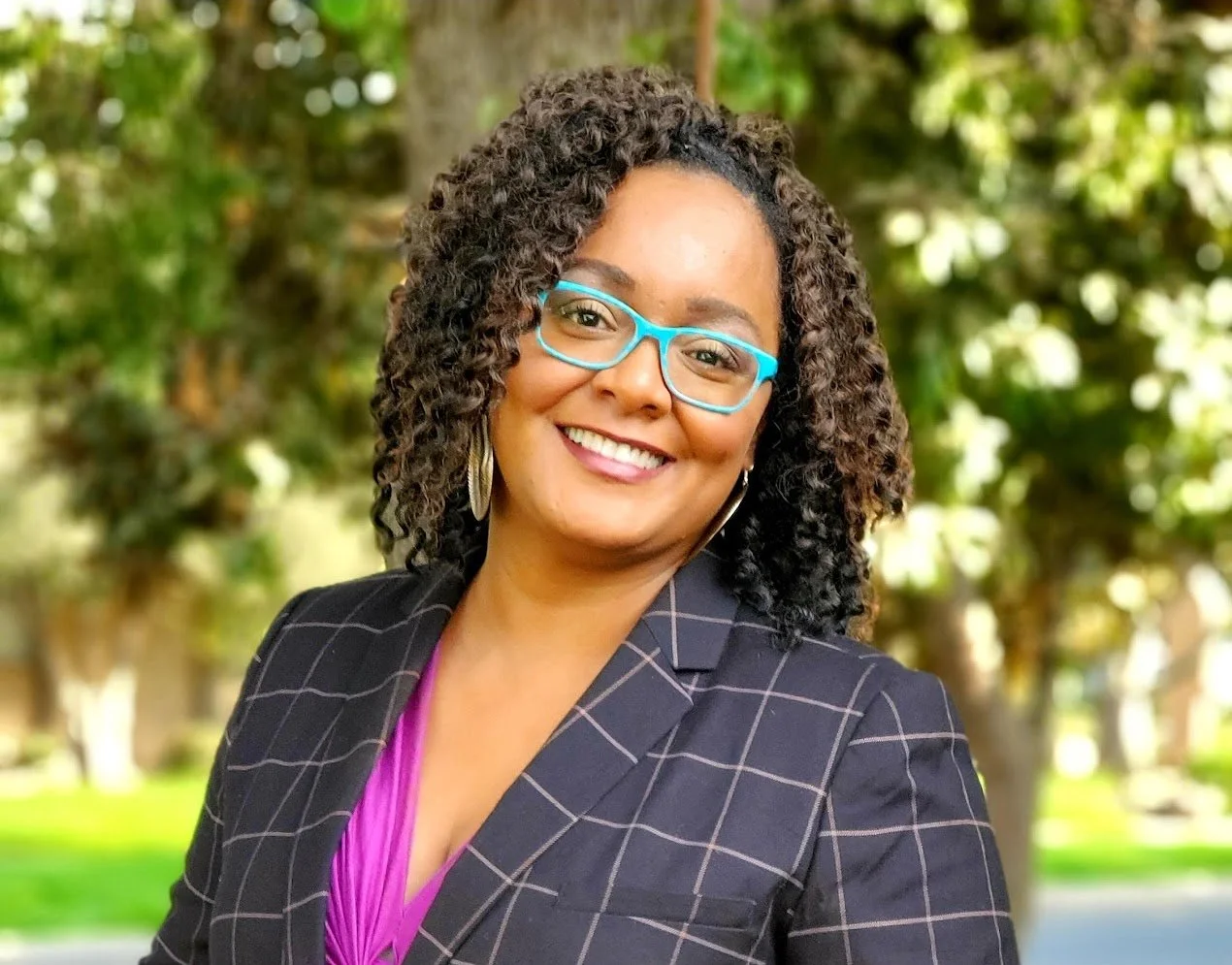
Cherise McBride
Sociocultural Learning Expert • Community-Engaged Scholar
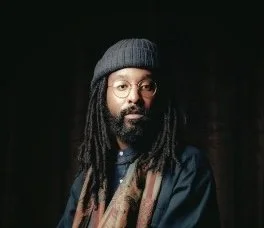
Musa Bey
IT/IS Manager
Black Cultural Zone

Walter Wallace
Executive Director
Black Film Guild
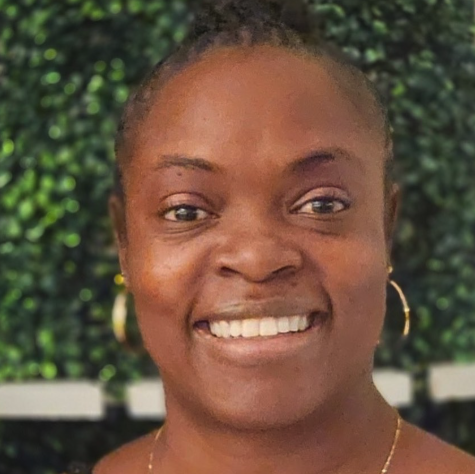
Dennisha Marsh
Executive Director
Parent of African American Achievement Collaborative Team

Paris Davis
Founder & CEO
CodedChange
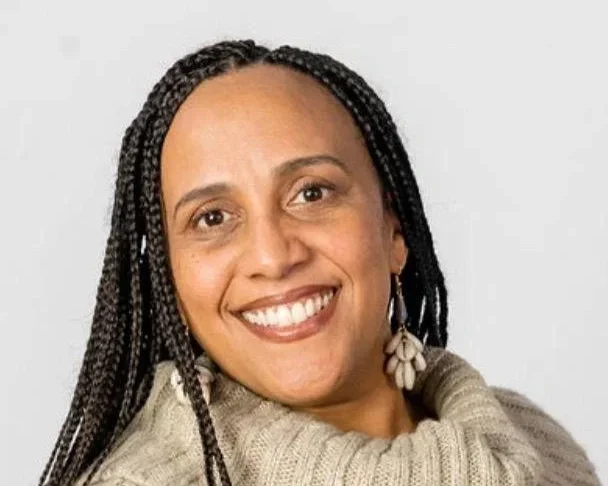
Wren Amos
Associate Executive Director & Director of Strategic Initiatives
Grown Women Dance Collective

Dominique Enriquez
Executive Director
Arts Education Alliance of the Bay Area
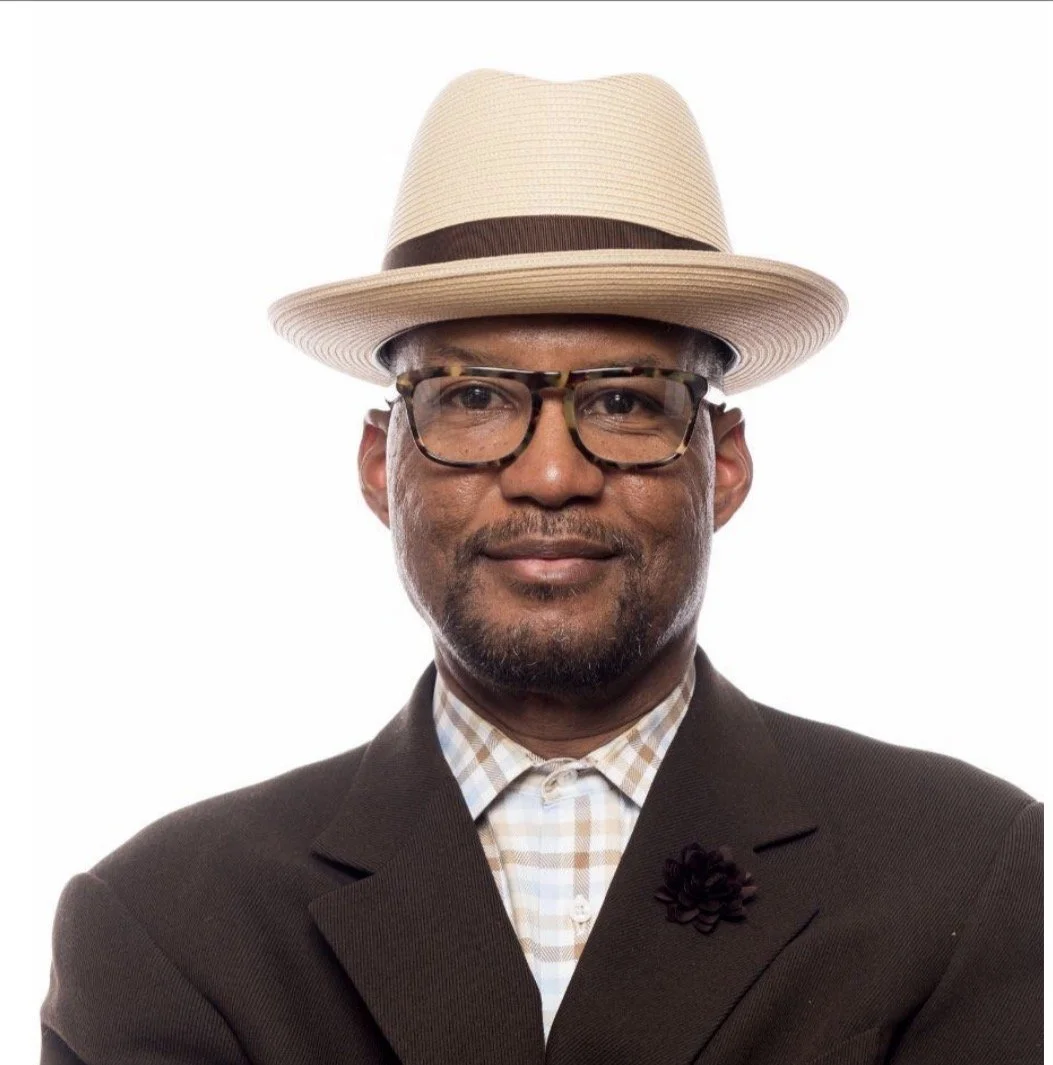
Randolph Belle
Executive Director
EVOAK!
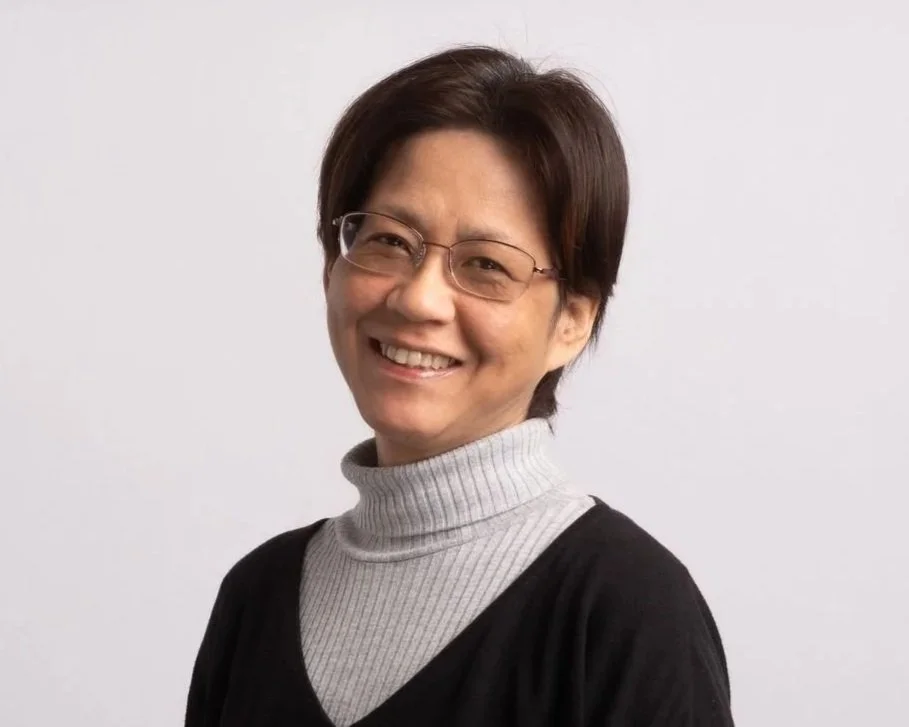
Yuka Nagashima
Executive Director
Food Shift, a project of Earth Island Institute
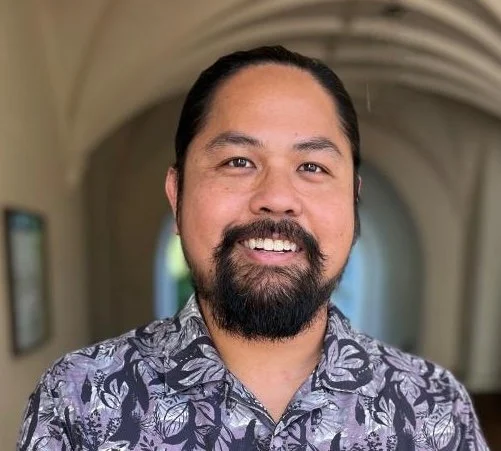
Ivan Natividad
Assistant Director of Communications
Othering & Belonging Institute at UC Berkeley
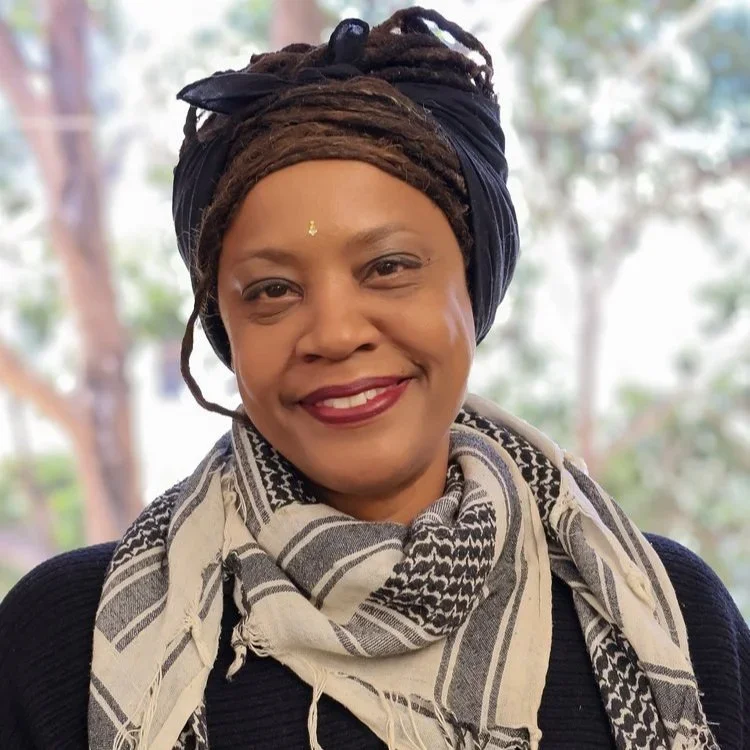
Sherry Congrave Wilson
Executive Director
The Town Project

Attendee chose anonymity.
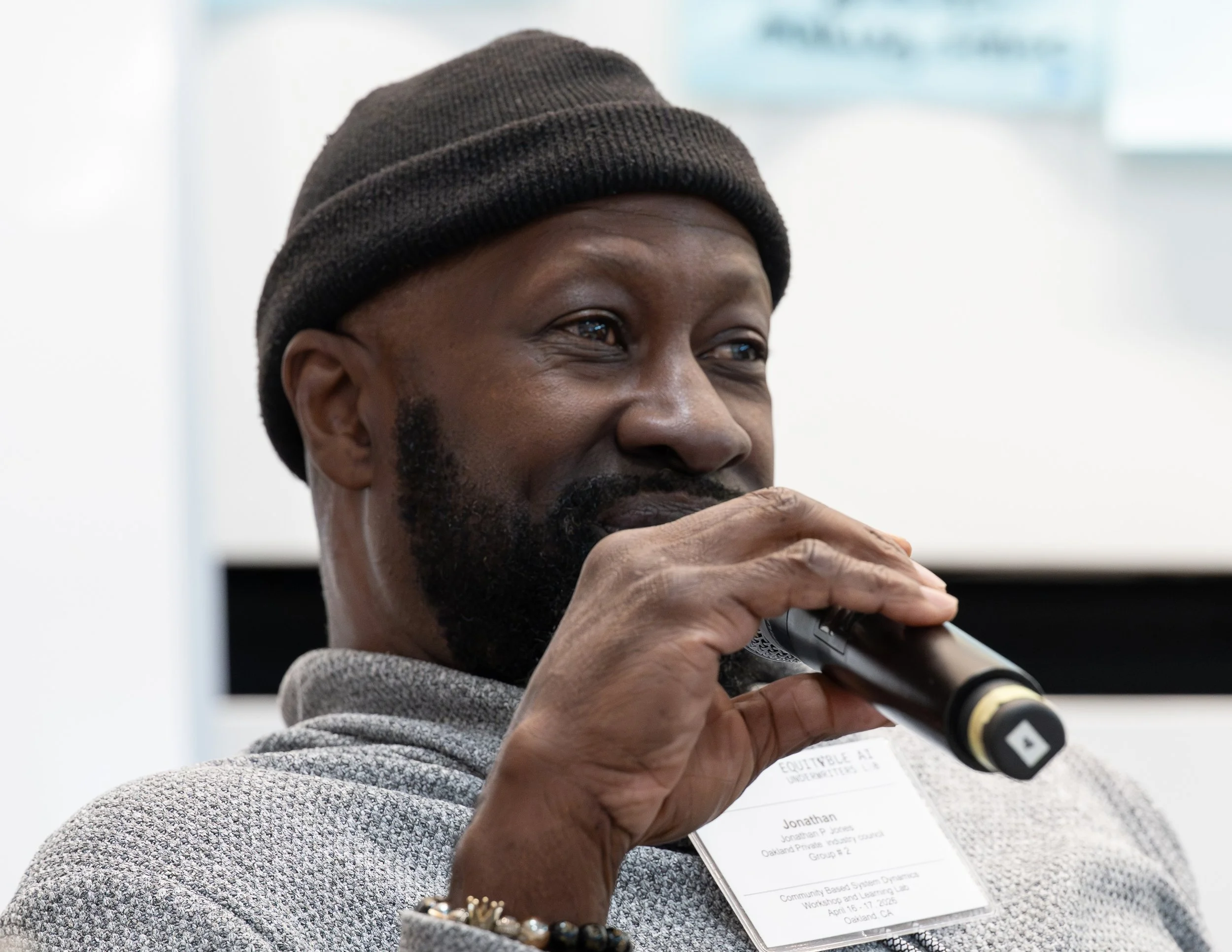
Jonathan P Jones
Board Director
Oakland Private Industry Council

Outcomes and Insights
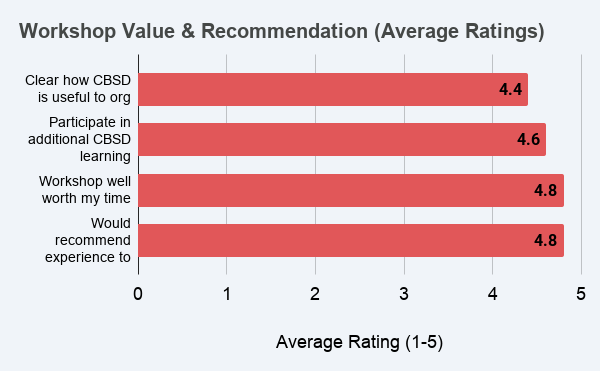
Workshop value was evident: The questions "Attending the workshop was well worth my time" and "I would recommend this learning experience to others" both received an average score of 4.8 out of 5.
87% of participants saw clearly how community based system dynamics (CBSD) could be useful to their organizations.
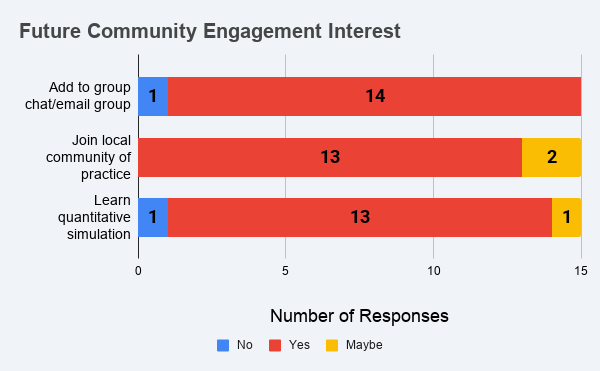
The seeds for a local CBSD community of practice were successfully planted.
87% of participants expressed interest in joining a local community of practice.
46% of participants who said ‘Yes’ attended the first monthly meetup.
System Dynamics is Challenging to Learn
A 2-day workshop is not enough time for anyone to become proficient in system dynamics. Experts typically have a minimum of a Master’s degree in the discipline.
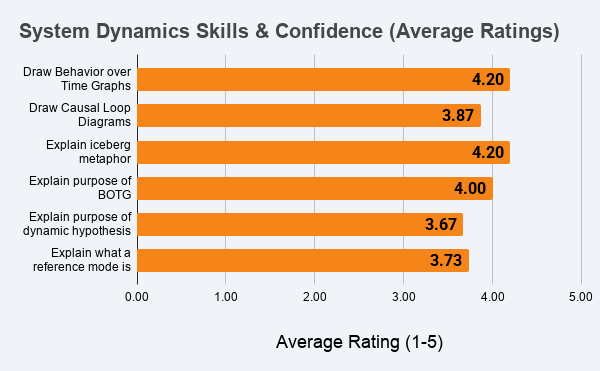
Although participants felt fairly confident about their ability to explain and use the iceberg metaphor and Behavior Over Time Graphs (BOTGs), confidence drops off steeply with more advanced concepts like causal loop diagrams (CLDs) and reference modes.
Key Insight: An introductory workshop is just the beginning. Scaling post-workshop continuous learning through real-world application remains the key constraint and opportunity.
→
→
→
Post-Workshop Comments
The Problem
System Dynamics is not intended for directly modeling large ecosystems. It is a method for modeling specific problems as dynamically complex systems. The first step is choosing the problem domain and specific problem to model.
Prior to the workshop participants chose education funding as the problem domain for learning.
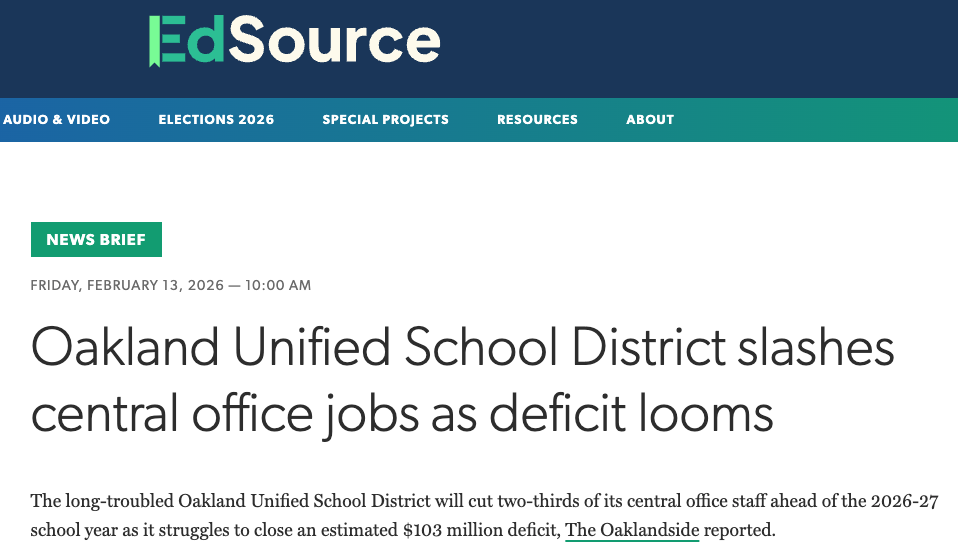
To ensure that learning activities and artifacts were relevant to Oakland, the Oakland Unified School District funding deficit was chosen as the specific problem.
The Reference Mode
A reference mode is a graphical representation of the key factors/variables of a problem and how they have behaved over time from the past up until present day.
It is the first and most important step in modeling a problem with system dynamics.
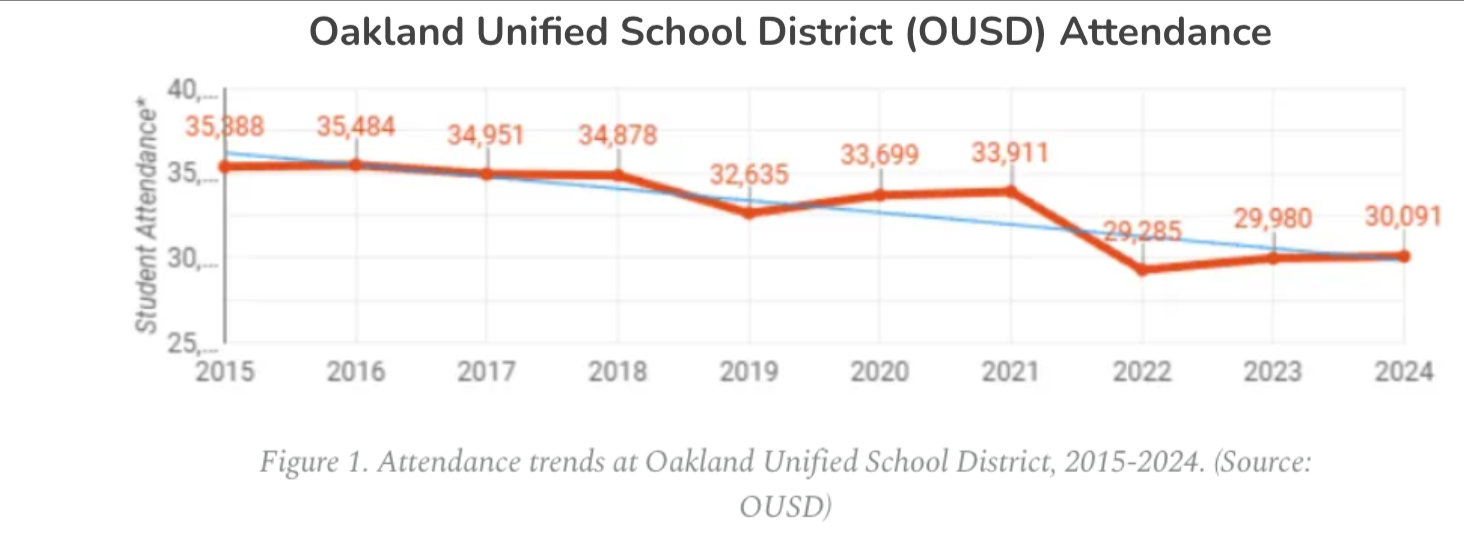
For the OUSD funding problem, attendance is the key variable that policy makers focus on as OUSD funding is based on attendance levels.
The Behavior Over Time Graph (BOTG) below represents how OUSD attendance has changed over time. The fact that it has been trending down is a key indicator that there is a problem.
Activities & Artifacts
Surfacing Hopes and Fears
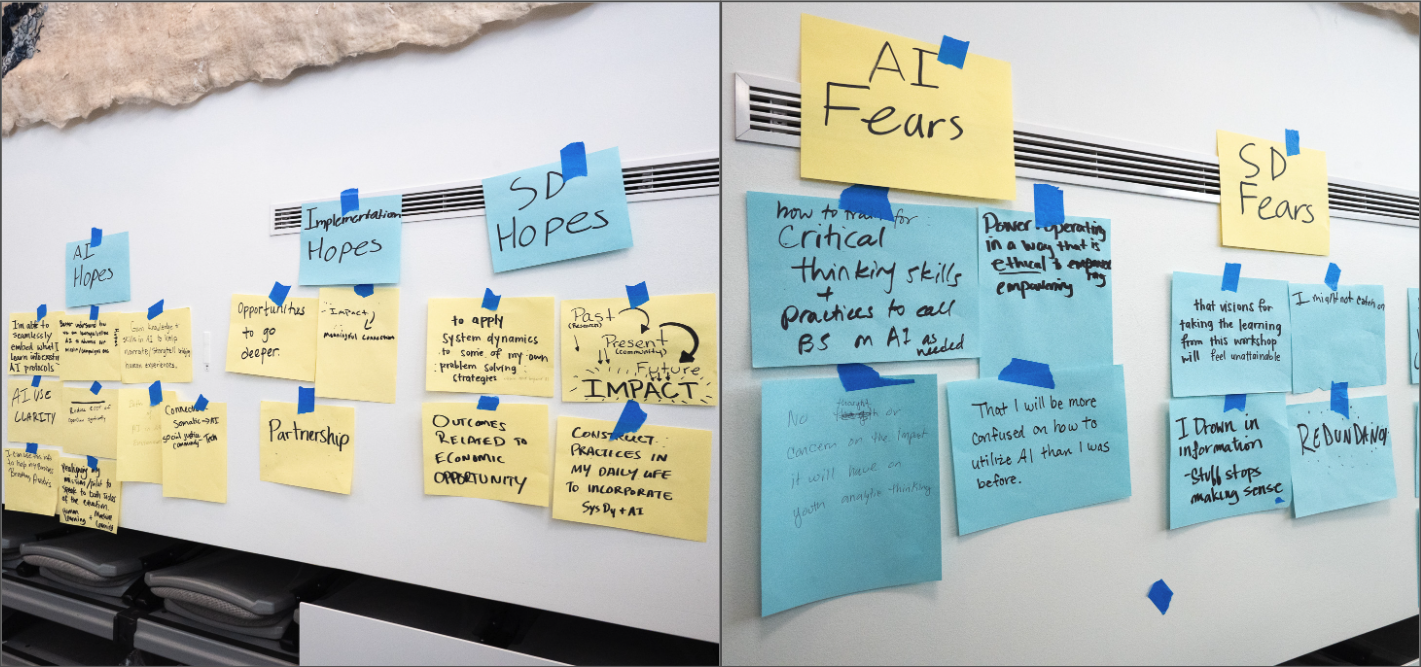
The Hopes and Fears activity sets the expectations for the workshop itself. Participants expressed hopes and fears about the usefulness of what they would learn about system dynamics and its relation to AI.
The groups hopes and fears are revisited at the end of the workshop to assess whether fears were mitigated and hopes realized.
Drawing Behavior Over Time Graphs
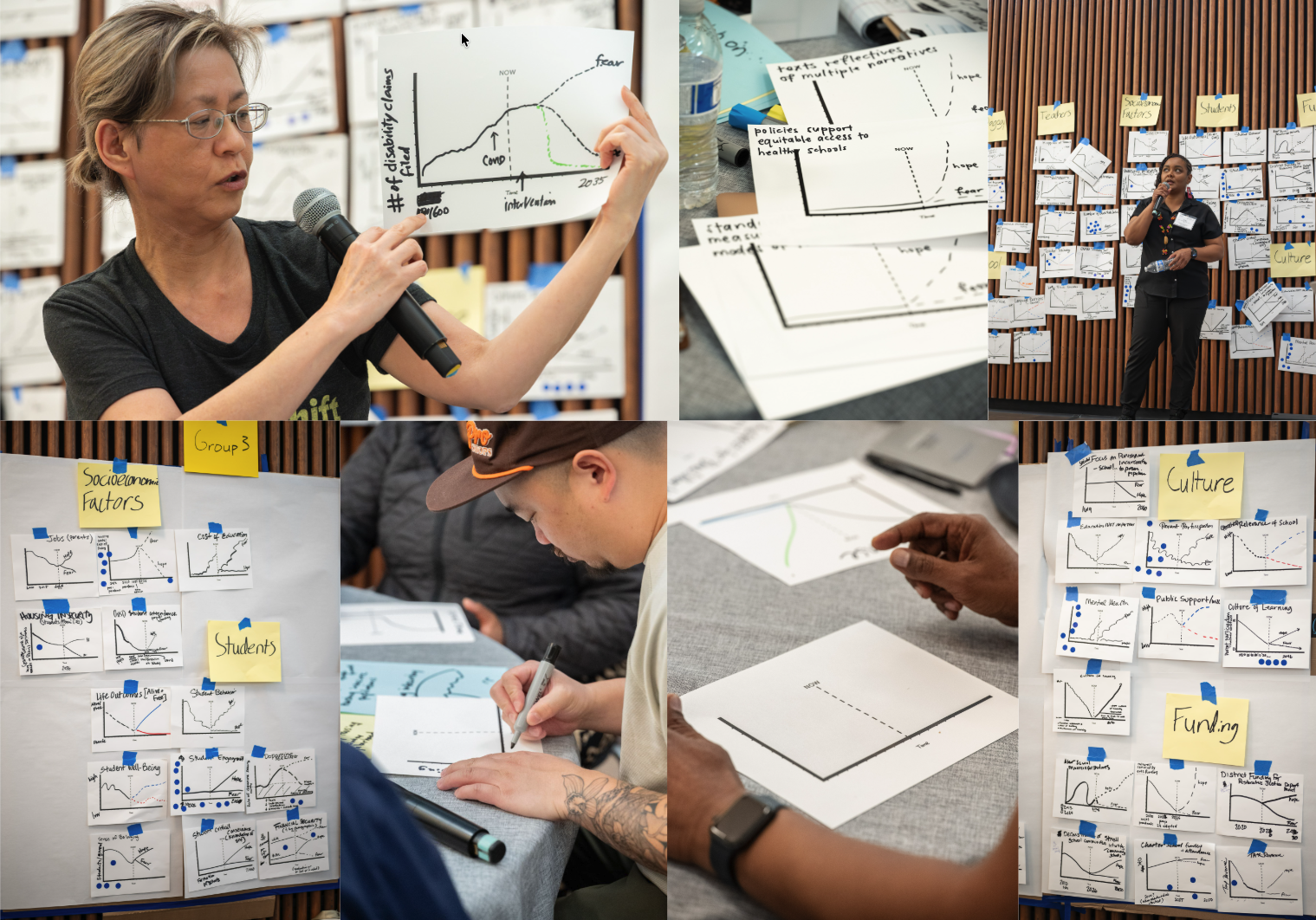
By drawing Behavior Over Time Graphs (BOTGs) participants learn to shift focus from isolated, single events to long-term historical patterns and trends when describing a problem. The patterns are the problem!
Drawing BOTGs helps elicit what factors/variables matter the most and how they have been changing might be measured. There is no expectation that data for those variables already exists. BOTGs help determine what data is essential.
For the funding problem participants expressed their lived-experience intuition about what other variables (e.g. belonging, community, purpose) matter for the funding problem using BOTGs.
Drawing Causal Loop Diagrams
To truly understand a problem we must understand the underlying causal structure or system that is generating the key patterns we call a problem. A Causal Loop Diagram (CLD) is used to visually express a theory or “dynamic hypothesis” of what that causal structure could be.
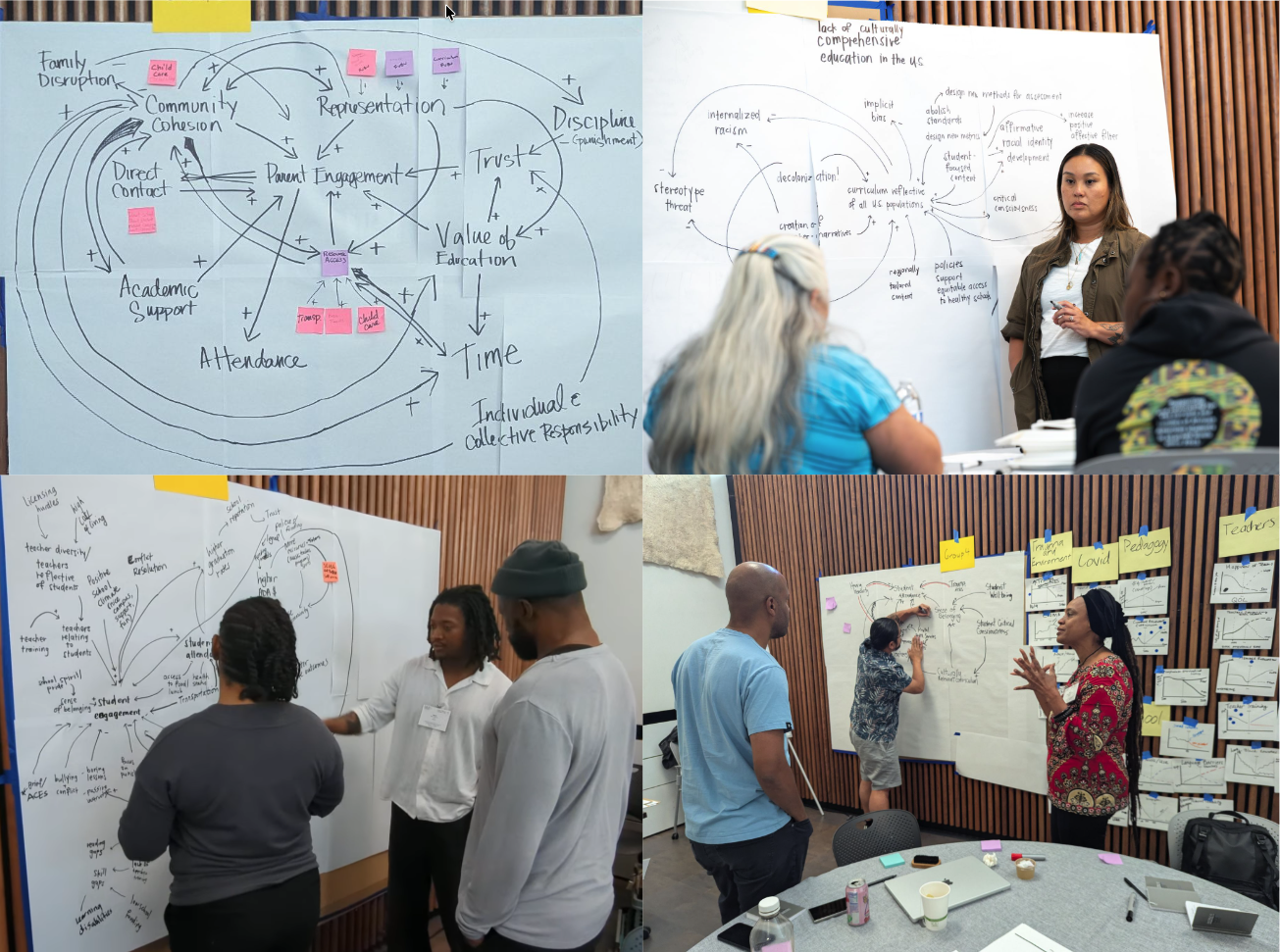
Participants were divided into four groups; each developed their own “dynamic hypothesis” of the causal structure generating OUSD’s pattern of attendance decline using a CLD.
Variables they identified during the Behavior Over Time Graph activity served as key sources of causal factors for their visual causal maps.
Quantification & Simulation
The journey from a visual causal loop diagram (CLD) of a problem’s structure to a mathematical simulation model of the problem is long and challenging and was well beyond the scope of the workshop.
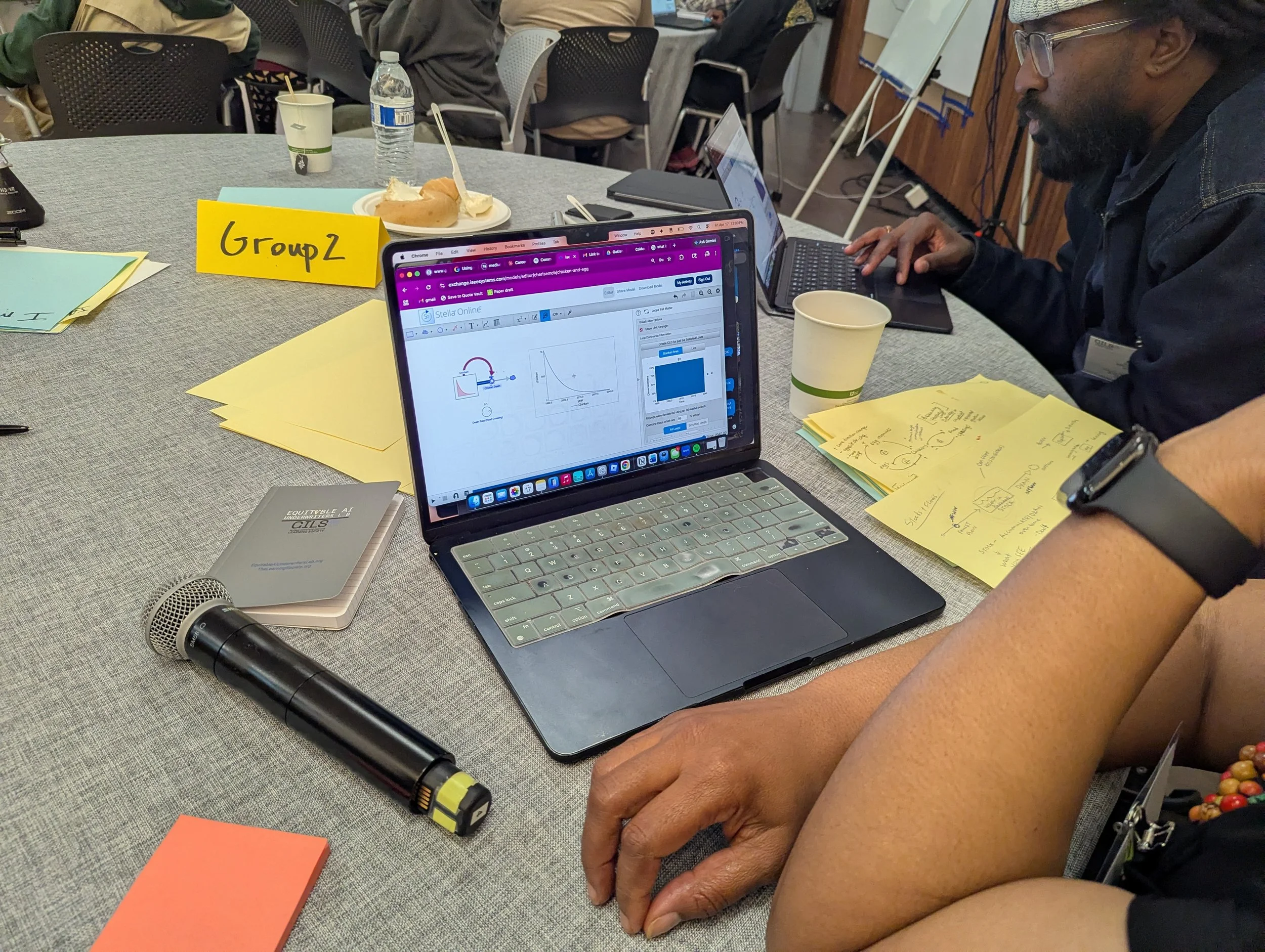
Participants received a 2 hour introduction to computational problem modeling and simulation using system dynamics tools.
Key Insight: Current tools for building quantitative simulation models tend to be expensive and non-intuitive. This is another key constraint and opportunity.
Synthesis
In a learning session where independent groups create causal loop diagrams (CLDs) for the same problem, a key task is to convert the hand drawn diagrams into digital form and synthesize them into one. The entire group reviews and signs off on the synthesized CLD. The process used for this workshop is illustrated below.
-1-
Each of 4 groups developed their own “dynamic hypothesis” of the causal structure generating the attendance reference mode using a CLD.
-2-
Dr. John Pastor Ansah synthesized the four CLDs and identified a core structure common to them all. Belonging was identified as a key variable.
Click any image to enlarge.
-3-
Based on the core structure Dr. John Pastor Ansah synthesized the four CLDs into a single CLD.
Post-Workshop
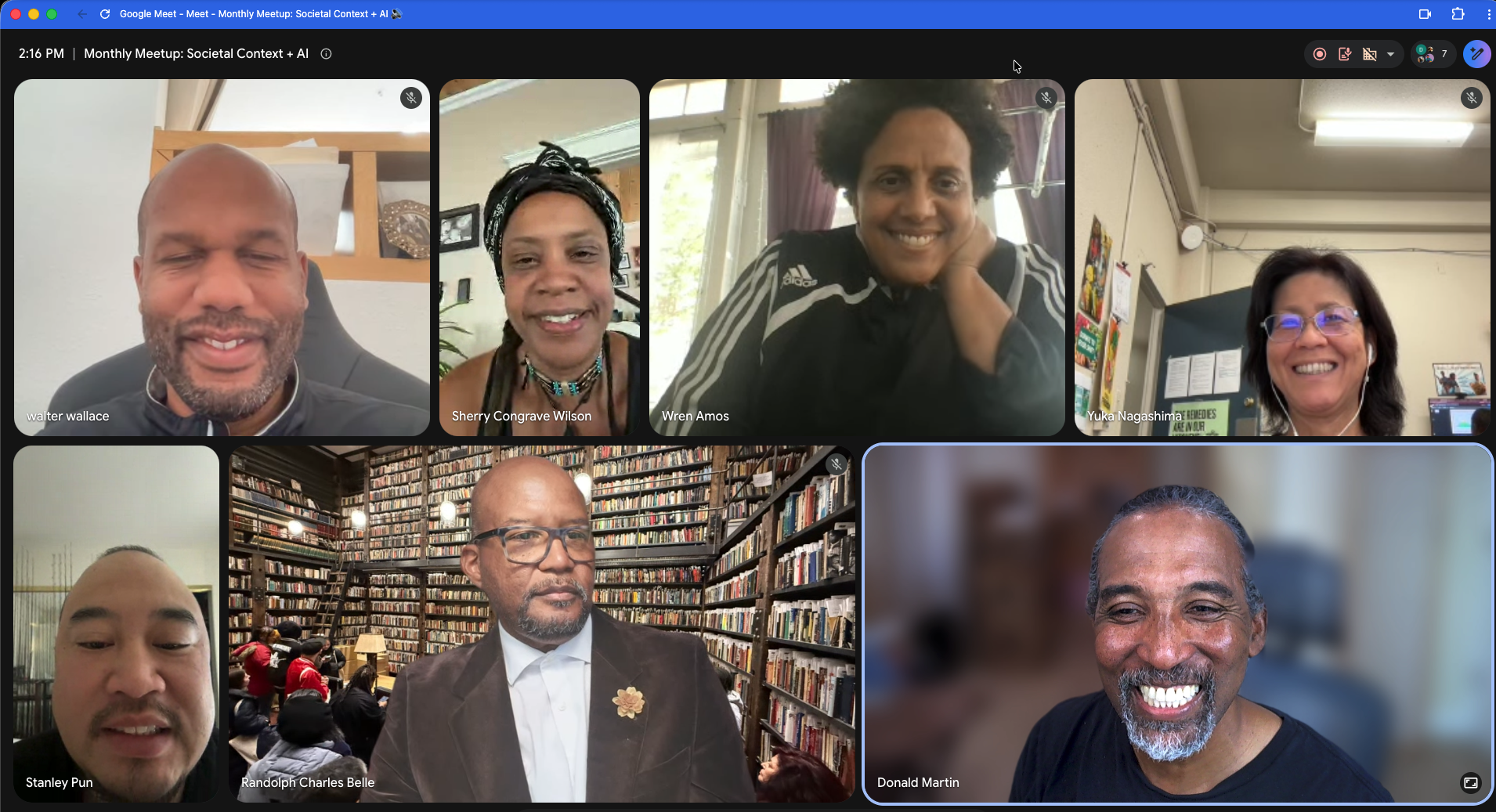
AI + Societal Context Monthly Meetup
A key goal of the workshop was to seed a local CBSD community of practice. The first monthly meeting was held July 20, 2026.
Proof -of-Concept Simulation Model & Interface
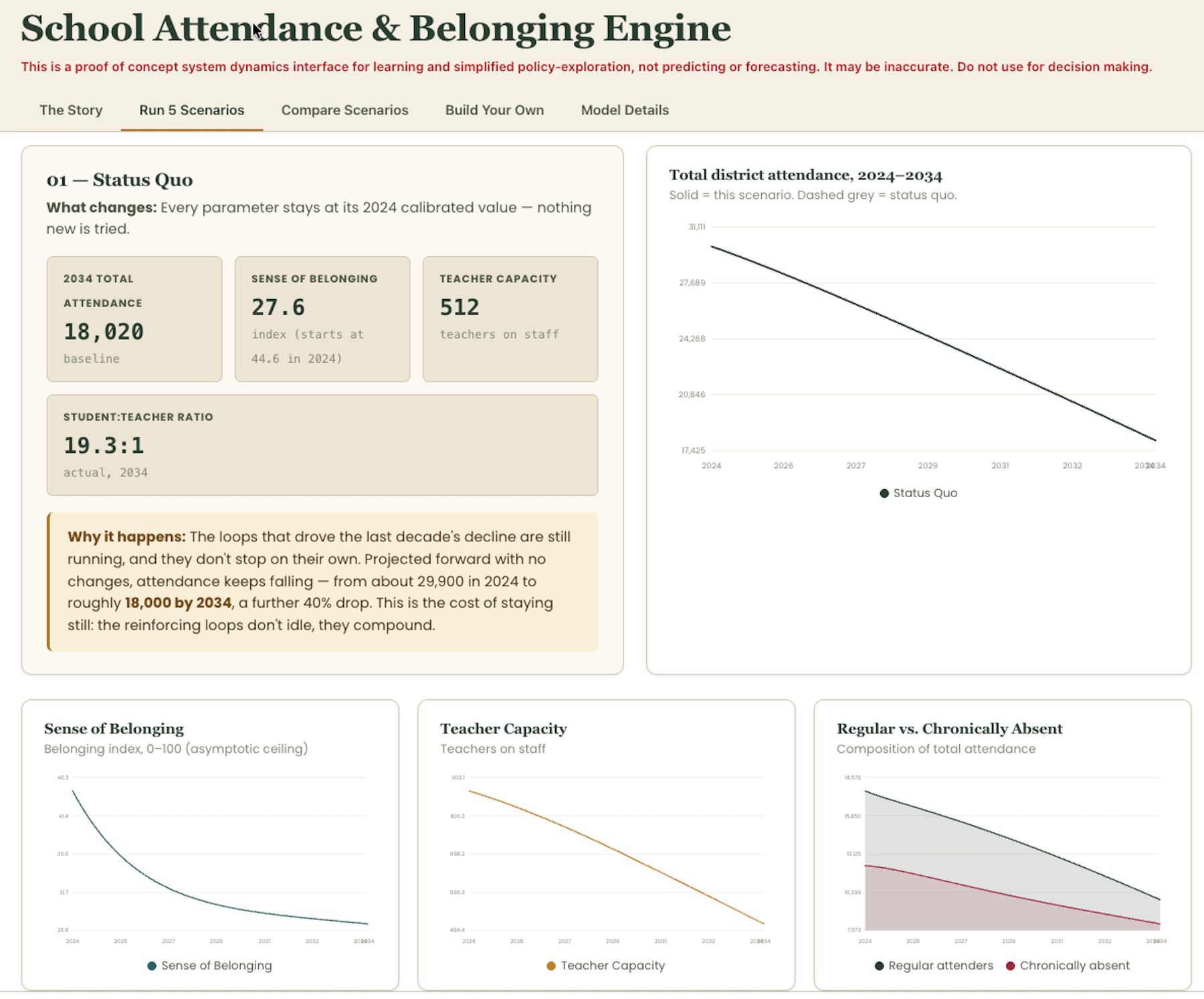
We transformed the core structure CLD developed in the workshop into a proof-of -concept simulation model and interface.
Instructors & Facilitators
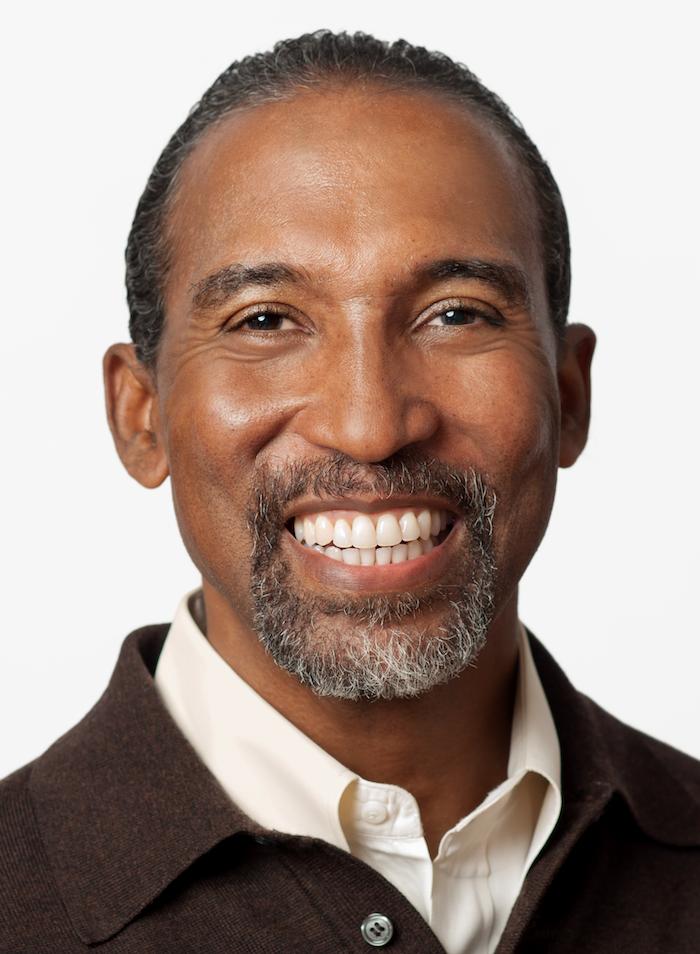
Donald Martin, Jr
Founder + CEO
Global Institute for the Learning Society (GILS)

Dr. John Pastor Ansah
Assistant Professor, Center for Community Health Integration, School of Medicine, Case Western Reserve University
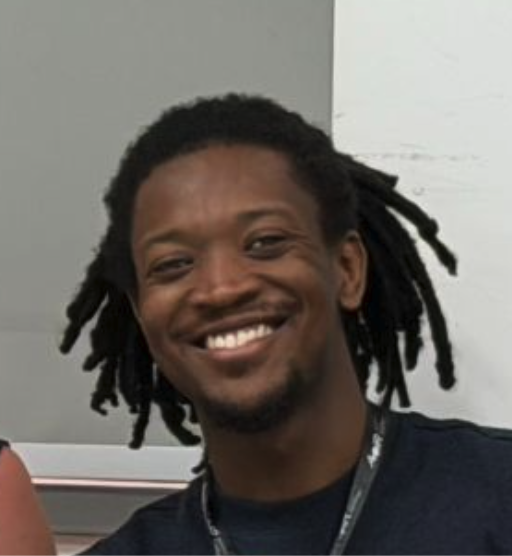
Ngozi Harrison
PhD student,
Information Studies, UCLA